
Before machines: bagatelle and the plunger
Pinball's ancestor is bagatelle, an 18th-century table game from France in which players shot balls with a cue up a sloping board studded with pins and into scoring holes. It was a parlour and pub game, not a machine.
The first part of modern pinball to appear was the plunger. In 1871 Montague Redgrave, a British-born inventor living in Cincinnati, received a US patent for improvements to bagatelle that included a coiled spring and plunger to launch the ball, along with a sloped table and smaller balls. That spring plunger is the direct ancestor of the one you still pull on almost every pinball machine.
1931: the first coin-operated hits
Coin-operated bagatelle games appeared in the United States at the start of the 1930s, during the Great Depression. They were small countertop cabinets with no electricity at all. For a coin you got a handful of balls to launch, and you watched them bounce through pins into scoring pockets.
Several companies built these games around 1931, and historians argue over which came first. The best known is Baffle Ball, released by David Gottlieb's company in late 1931. It was a huge hit, reported to have sold in the tens of thousands, and it helped turn Chicago into the capital of the pinball industry. The following year Ballyhoo became such a success that its maker named a new company after it: Bally.
The first electric pinball
Electricity arrived quickly. In 1933 Harry Williams designed Contact, which used an electric solenoid to kick the ball out of a scoring hole and back into play, and rang a bell when you scored. It is usually credited as one of the first electrically powered pinball games, and it showed that pinball could be more than balls falling through pins.
Williams is also credited with the tilt. Players had learned to lift and shake machines to guide the ball, so he added a mechanism that stopped the game when the cabinet was pushed too hard. TILT has been part of the game ever since, and the expression 'on tilt' passed from pinball into everyday English.
1947: the first pinball machine with flippers
For its first fifteen years pinball had no flippers. A player could launch and nudge, but not hit the ball back up. That changed in 1947 with Humpty Dumpty, a Gottlieb machine designed by Harry Mabs. It had six small flippers, three on each side of the playfield, and it turned pinball from a game of chance into a game of skill.
Designers soon found a better arrangement. Within about a year, machines were using two larger flippers at the bottom of the playfield, facing each other above the drain, and that layout is still the standard today.
Why the 'first' is so hard to pin down
Pinball's early history is messy for good reasons. In 1931 and 1932 dozens of small companies, many of them in Chicago, were copying and improving each other's games within weeks. Records of production were rarely kept, patents were filed for ideas that never became products, and many machines were sold under different names in different cities.
That is why careful historians talk about 'one of the first' rather than 'the first'. The safest summary is this: the plunger dates from 1871, coin-operated pinball took off in 1931, electricity and the tilt arrived in the following few years, and flippers in 1947. Everything else in a modern machine was built on top of those four steps.
Other firsts worth knowing
Once the basic machine was in place, new ideas kept arriving. Some milestones that are commonly cited:
- Solid state: in the mid-1970s the first machines with microprocessors replaced relays; by the end of the decade almost every new machine was solid state.
- Speech: the first talking pinball machines appeared in the late 1970s.
- Dot-matrix display: the first machines with a dot-matrix display came out in 1991, opening the door to animations and video modes.
- Digital pinball: pinball arrived on home computers in the early 1980s, and today full physics tables run in a browser tab.
Your first table in Bubble Pinball
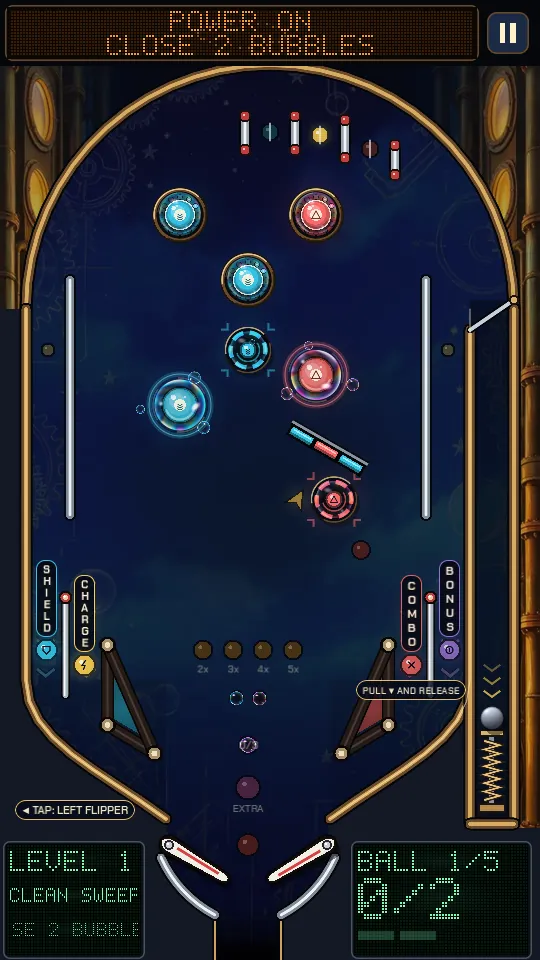
Every one of those firsts is still in a modern table: the plunger from 1871, the pins that became pop bumpers, the tilt from the 1930s and the two flippers from the late 1940s. Bubble Pinball keeps all of them and adds one idea of its own, colour. Rings paint the ball, and a bubble only breaks when a ball of its own colour hits it.
Our own first table is called Power On. It has a triangle of pop bumpers, a cyan charge ring right below it, a coral ring by a drop-target bank and two bubbles to close. It is calm and open, made for learning to trap the ball and aim, and it is the start of a free campaign of 100 tables in five worlds. Play it now: no download, no account.
Frequently asked questions
What was the first pinball machine?
It depends on the first what. Coin-operated countertop pinball games appeared around 1931, Baffle Ball being the best known; Contact (1933) was among the first electric ones; Humpty Dumpty (1947) was the first with flippers.
Who invented the pinball plunger?
Montague Redgrave patented a bagatelle with a spring plunger in the United States in 1871.
When were flippers added to pinball?
In 1947, on Humpty Dumpty, which had six flippers along the sides. The two-flippers-at-the-bottom layout followed shortly after.
Where can I play pinball for free?
Bubble Pinball is a free pinball game in your browser, with 100 tables, on phone, tablet or computer.