
The cabinet, the playfield and the ball
A classic pinball machine is a wooden cabinet on four legs with a glass-covered playfield and an upright head, the backbox, at the far end. The playfield slopes down towards the player by a few degrees, usually around six and a half, and that slope is what always brings the ball back to you.
The backbox holds the backglass, the painted art that gives the machine its identity, and the score display: spinning reels on old machines, segment displays later, and from the early 1990s an orange dot-matrix display (DMD). The ball is a solid steel sphere, 1-1/16 inches (about 27 mm) across and roughly 80 grams.
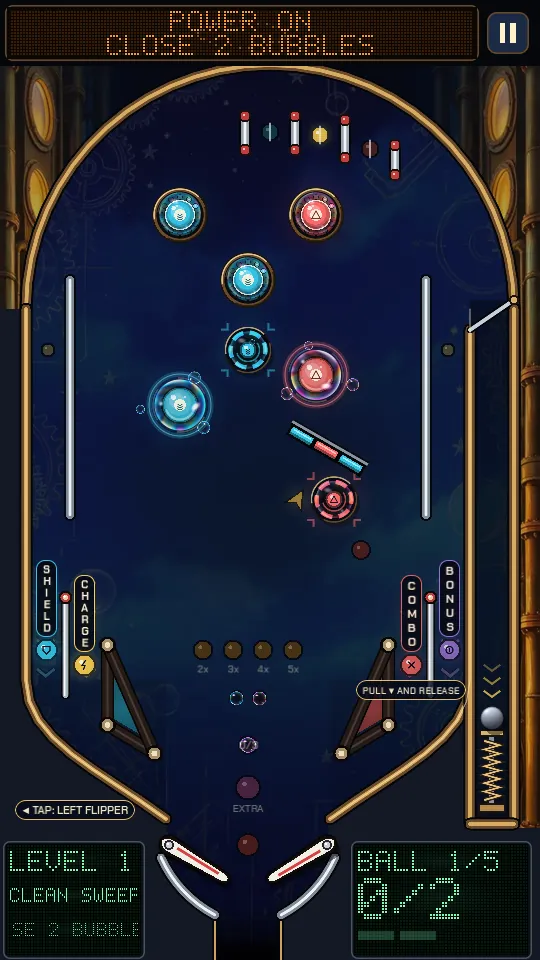
Bubble Pinball keeps that layout on one portrait screen, with a DMD-style display at the top for your score, the table's mission and messages such as SKILL SHOT or TILT.
Pinball flippers
Flippers are the only parts you control directly. Each one is a short bat driven by a solenoid (an electric coil) and fired by a button on the side of the cabinet. Most machines have two at the bottom, one each side of the centre drain, and some add a small upper flipper.
Where the ball meets the flipper decides where it goes: struck near the tip it travels to the far side, struck near the base it goes more to the near side. Holding a flipper up lets the ball settle in the crook between flipper and rail, which is how players stop the ball and aim.
In Bubble Pinball you hold the left or right half of the screen (or the arrow keys) to raise each flipper. Crystal Greenhouse adds a mini flipper and Storm Foundry a pair of them.
Pinball slingshots
Just above each flipper sits a triangular block wrapped in rubber: the slingshot. When the ball touches the rubber on the inner face, a switch fires a kicker arm that snaps the ball sideways. Slingshots are why a ball that looks safe can suddenly shoot across to the other side.
Bubble Pinball copies real slingshot geometry, a tall narrow triangle beside each inner lane with its rubber angled at the centre, so the ball kicks where your hands expect.
Pop bumpers
Pop bumpers, also called jet bumpers, are the round posts usually grouped in threes near the top of the playfield. When the ball brushes the skirt at the base, a solenoid pulls a ring down and fires the ball away. A ball caught between bumpers can bounce several times a second, which is where the machine-gun sound of pinball comes from.
Bumpers score on every hit, and in Bubble Pinball they also feed the colour game: on table 1 a cyan and coral bumper triangle sits right above a cyan charge ring, so a ball tumbling out of the bumpers often comes down charged.
Ramps and orbits
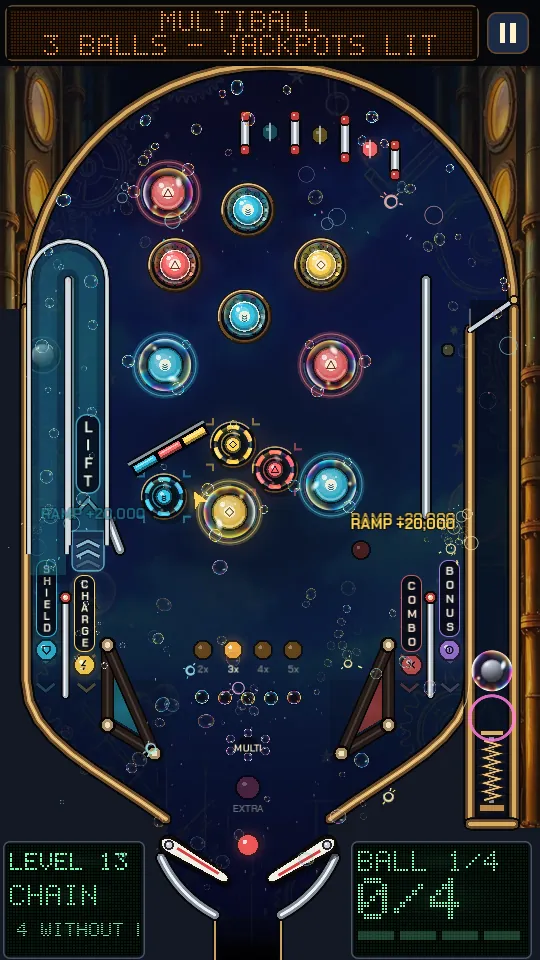
A ramp is an inclined track, clear plastic or a metal wireform, that carries the ball up off the playfield and returns it to a flipper. Ramps are the classic high-value shot: they need aim and usually feed the ball straight back so you can shoot again. Orbits (or loops) run around the edge of the playfield: a ball shot into one travels over the top and comes out of the other side.
Bubble Pinball has two raised ramps, LIFT and CASCADE. Every ramp shot inflates the Mother Bubble; fill it and it bursts into a three-ball multiball. Left and right orbits sit on every table, Foam Sea adds a spiral ramp and Stellar Crown a full-width ring ramp.
Drop targets, standup targets and spinners
Drop targets are flat targets that sink into the playfield when hit. They come in banks, and knocking down the whole bank usually awards something before they reset. Standup targets are fixed: they register a hit and stay put. A spinner is a flat metal flag on a wire across a lane; a clean shot makes it spin and every turn scores.
Many Bubble Pinball tables have a drop-target bank. Clear it twice in one game and you earn an extra ball. Some layouts also bolt a spinner into the orbit lanes, so a clean orbit shot pays twice.
Saucers, scoops, kickers and captive balls
A saucer is a shallow cup that catches a slow ball, holds it for a moment while an award runs and then kicks it back out. A scoop swallows the ball, sometimes sending it through a hidden subway under the playfield. A captive ball is trapped in its own short lane: you hit it with the main ball to push it towards a target.
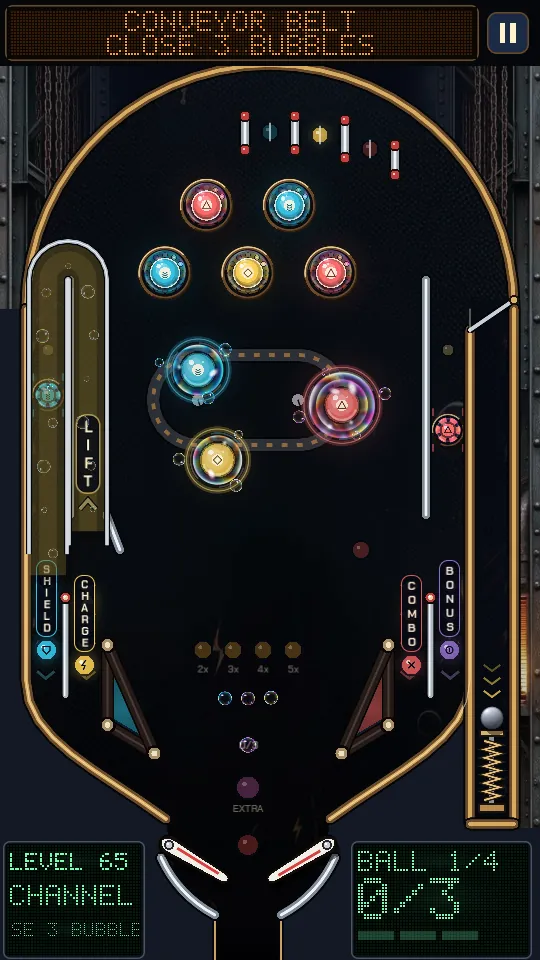
These arrive gradually in Bubble Pinball: Foam Sea brings a saucer, a captive ball and a motorised carousel, Storm Foundry a subway and a kicker, and Stellar Crown a black hole built around a saucer with an escape slot.
The plunger and the skill shot
The plunger is the spring-loaded rod in the shooter lane, normally on the right. Pull it back, let go, and the ball launches. Many machines reward a precise launch with a skill shot: a lit lane or target hit straight from the plunger.
In Bubble Pinball you swipe down on the right half of the screen (or hold Space) and let go. At the top, three rollover lanes wait; one is lit, you can move it with the flippers, and landing in it scores a skill shot worth more each time you make one on the same table. Read the details in our rules guide.
Inlanes, outlanes and the drain
At the bottom of each side, lanes run down past the slingshots. On a real machine the inner ones (inlanes) feed the ball onto the flipper, while the outer ones (outlanes) drop it out of play. The gap between the flippers is the centre drain, and losing a ball down either is called draining.
Bubble Pinball is kinder: both lanes on each side lead onto the flipper, so there are no side drains, and each lane has a job. SHIELD gives a 6-second ball saver, CHARGE paints the ball with the colour of an open bubble, COMBO boosts the next bubble you close and BONUS adds points and progress towards an extra ball. Light all four and Bubble Rain starts: double scoring for 20 seconds.
The tilt mechanism
Players have always bumped machines to guide the ball, and the tilt mechanism is how a machine fights back. The classic version is a plumb bob, a weight hanging inside a metal ring: nudge too hard and it touches the ring. You get a warning or two, then TILT: the flippers go dead, the ball drains and its bonus is lost. A separate slam tilt ends the whole game if someone hits the cabinet violently.
In Bubble Pinball you nudge with the up arrow or Shift. Small, early nudges help; too many and the machine warns you, then tilts like the real thing.
The parts only Bubble Pinball has
On top of the classic parts, Bubble Pinball adds its own pieces. Charge rings (ports) paint the ball with a colour: cyan, coral, amber and, from the third world, violet. Glowing bubbles float on the playfield, and a bubble only breaks when a ball charged with its own colour hits it. Big bubbles wear several shells, and closing one leaves a module behind: a magnet, an extra pop bumper, a rescue post between the flippers or a prism that doubles points.
That one rule turns every part above into a decision: go through the ring first, or straight for the ramp that charges on the way? The free campaign has 100 tables in five worlds, each with its own layout and mission. Start with table 1 and you will meet most of these parts within the first world.
Frequently asked questions
What are the main parts of a pinball machine?
The cabinet and backbox, the sloped playfield, the steel ball, the plunger, two or more flippers, slingshots, pop bumpers, ramps, orbits, targets, lanes and the tilt mechanism. Many machines add saucers, spinners, captive balls, magnets and toys.
What is the difference between a slingshot and a pop bumper?
A slingshot is the triangular rubber above each flipper; it kicks the ball sideways. A pop bumper is a round post, usually higher up in a group of three, that fires the ball away in any direction when touched.
What is an outlane?
An outlane is the outer lane at the bottom of each side of a real machine. A ball that goes down it drains without reaching a flipper. Bubble Pinball has no side drains: all four side lanes feed the flippers.
Does Bubble Pinball have real pinball parts?
Yes. It has a plunger, flippers, slingshots, pop bumpers, ramps, orbits, drop-target banks, spinners, a saucer, a captive ball, a subway, a kicker and a tilt, plus its own colour rings and bubbles.