
Bagatelle: the ancestor
Pinball descends from bagatelle, a table game popular in 18th-century France. Players used a cue to shoot small balls up a sloping table studded with pins and into scoring holes. The name is usually linked to the Château de Bagatelle near Paris, where, as the story goes, a version was played at a party for King Louis XVI.
Bagatelle crossed to Britain and America in the 19th century. In 1871 Montague Redgrave, a British-born inventor in Cincinnati, patented improvements that included a coiled spring and plunger to launch the ball. That plunger is still on the right side of almost every pinball machine.
The 1930s: coin-operated pinball is born
During the Great Depression, small coin-operated bagatelle games became a cheap entertainment for bars and shops. Early hits were countertop games with no electricity at all: you paid a coin, launched a handful of balls and watched them fall through pins into pockets. Several of the manufacturers that dominated pinball for the next sixty years started in these years in Chicago, and one of them even took its name from an early hit game called Ballyhoo.
Electricity arrived within a couple of years, bringing bells, lights and solenoid kickers. So did the tilt. Players had learned to lift and shake machines to steer the ball, and designer Harry Williams is credited with adding a mechanism that stopped the game when a machine was pushed too hard.
Pinball on trial: the bans
Before flippers, a pinball player could only launch and nudge, so the result looked a lot like chance. Some machines also paid out prizes. To many authorities pinball was simply a gambling device, and cities began to ban it.
The best-known ban came in New York City in 1942. Mayor Fiorello La Guardia had machines seized, and photos of him smashing them with a sledgehammer became famous. Chicago and Los Angeles also banned pinball, and the New York ban lasted until 1976. Pinball survived in other cities and countries, but for more than thirty years it carried a disreputable image.
1947: the flipper changes everything
In 1947 a machine called Humpty Dumpty introduced player-controlled flippers. It had six small flippers, three on each side of the playfield, and for the first time a player could hit the ball back up instead of just watching it fall. Within a year or two designers settled on the layout still used today: two flippers at the bottom, facing inward, above the drain.
Flippers turned pinball into a game of skill. Over the 1950s and 60s electromechanical machines grew richer, with features such as multiball, drop targets and spinners, and pinball became a fixture of diners, bowling alleys and arcades.
1976: the called shot
The New York ban ended with one of pinball's great legends. In 1976 the writer and player Roger Sharpe testified before New York City Council members that pinball was a game of skill. To prove it he announced exactly which lane he would hit with his next plunge, then made the shot. The council voted to legalise pinball, and other cities followed.
Solid state, speech and the dot matrix
In the mid-1970s manufacturers replaced relays with microprocessors. Solid-state machines could remember what happened on earlier balls, run more complex rules and play electronic sound. The first talking pinball machines appeared at the end of the decade.
The early 1980s video game boom hit pinball hard, but the industry came back stronger. In 1991 the first machines with dot-matrix displays arrived, able to show animations and mini-games, and the early 1990s became a golden era: licensed tables based on films and TV shows sold in numbers not seen for decades. The best-selling machine of the modern era, from 1992, is usually said to have sold around twenty thousand units.
Decline and revival
By the late 1990s arcades were shrinking and home consoles were booming. In 1999 one of the biggest manufacturers left the pinball business, and for years a single major company kept building new tables. Pinball looked like a relic.
It came back. New manufacturers appeared in the 2010s, home collectors became a major market, bars began installing machines again, and competitive pinball grew into a scene with leagues, tournaments and world rankings. Modern tables add LCD screens and online updates, but the steel ball and the two flippers above the drain are the layout players met in the late 1940s.
One game, many names
Pinball travelled well and picked up local names. In German, French and Italian the machine is simply called a flipper. In Spain the traditional word is petaco. In Brazil, fliperama first meant pinball and later became the word for the arcade halls of the 80s and 90s. Japan developed pachinko, a vertical cousin that also grew out of bagatelle-style games but plays very differently.
From screens to browsers
Pinball moved onto screens as soon as home computers could draw a ball. The 1990s PC tables are still remembered fondly (we wrote a whole guide to classic PC pinball), consoles and phones followed, and today a full physics table runs in a browser tab.
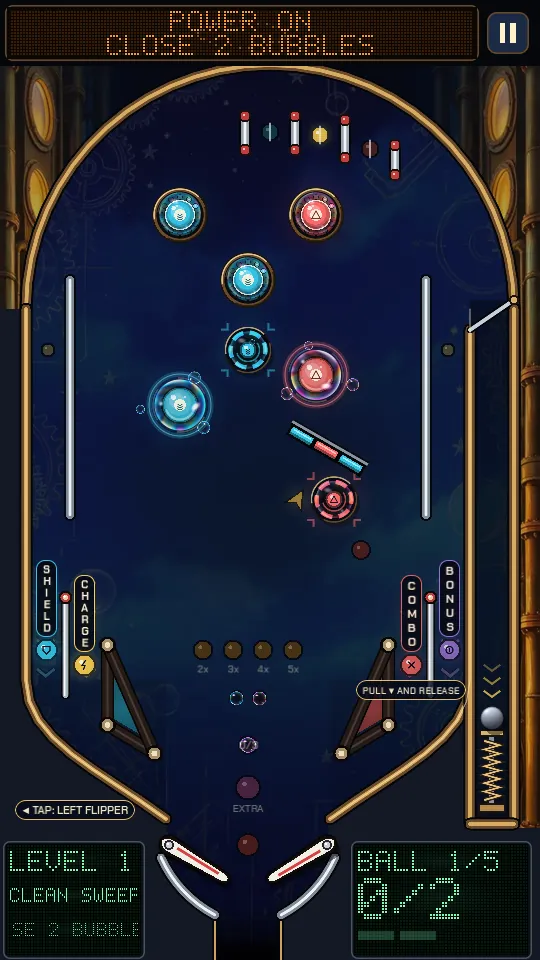
Bubble Pinball is part of that last chapter. It keeps the pieces history gave us, the plunger from bagatelle, the flippers from 1947, the tilt from the 1930s, slingshots, pop bumpers, ramps and multiball, and adds a colour rule: a bubble only breaks when a ball charged with its colour hits it. The free campaign has 100 tables in five worlds, and it loads in seconds on a phone or computer. Play it free and you are holding ninety years of pinball in your hands.

Frequently asked questions
When was pinball invented?
Pinball grew out of bagatelle, an 18th-century French table game. Coin-operated pinball appeared in the early 1930s, and flippers were added in 1947.
Why was pinball banned?
Before flippers, results depended mostly on chance, and some machines paid prizes, so many cities treated pinball as gambling. New York banned it from 1942 to 1976.
What was the first pinball machine with flippers?
Humpty Dumpty, released in 1947, with six flippers along the sides. The two-flippers-at-the-bottom layout followed shortly after.
Can I play pinball online today?
Yes. Bubble Pinball is a free pinball game that runs in your browser on phone, tablet or computer, with no download.