
Before the 90s: pinball on home computers
Pinball arrived on home computers early. In 1983 Bill Budge's Pinball Construction Set let players build their own tables by dragging bumpers, flippers and targets onto an empty playfield, then play them. It was a landmark in games that let players create, and it showed that a computer could simulate a ball convincingly enough to be fun.
Through the 1980s, though, most computer pinball was simple: one screen, basic physics and few rules. The big change came when machines like the Amiga and 386 and 486 PCs had enough power for smooth scrolling, sampled sound and proper ball physics.
The early 90s: scrolling tables and great music
In 1992 a small Swedish studio, Digital Illusions, released Pinball Dreams on the Amiga, followed the same year by Pinball Fantasies. Both came to the PC soon after. The tables were taller than the screen and the view scrolled smoothly with the ball, the physics felt weighty and every table had its own theme and a catchy soundtrack. Many players still hum those tunes.
In 1993 Epic Pinball arrived on DOS as shareware: the first table was free to play and share, and more tables came in paid packs. That model, try one table and buy more, put it on countless computers.
The table that came with the computer
The most played PC pinball of all was one nobody went out to buy. In 1995 Cinematronics and publisher Maxis released Full Tilt! Pinball, a collection of three tables: Space Cadet, Skulduggery and Dragon's Keep. A single-table version, 3D Pinball for Windows – Space Cadet, was included in the Microsoft Plus! 95 add-on and later shipped with several versions of Windows, including Windows 2000 and Windows XP.
That is why so many people remember it: it was simply there, on office and school computers around the world. It had a clever structure, with missions to pick and complete and a rank that climbed from cadet upwards as you finished them. It was also easy to pick up, with the Z and slash keys for the flippers and the space bar for the plunger.
It was dropped when Windows Vista came out. Microsoft developer Raymond Chen later explained on his blog that the 64-bit version had a collision detection bug that let the ball pass straight through objects, and that the team could not find the fix in the old, sparsely documented code, so the game was cut rather than shipped broken.
The late 90s: realism and 3D
As 3D graphics cards spread, pinball games split in two directions. Some chased realism: the Pro Pinball series, starting with The Web in 1995 and continuing with Timeshock! in 1997, modelled real ball physics, real displays and deep rule sheets that would not have looked out of place in an arcade. Others went for fantasy, with tables full of animated creatures and moving toys that a physical machine could never hold.
By the end of the decade PC pinball had shown everything that digital pinball can be: faithful simulation, pure fantasy and, in the bundled Windows table, a game that almost anyone could start in two seconds.
What made them great
Looking back, the classics shared a few qualities that still matter:
- Instant play: no setup, no account. You opened the game and the ball was in the plunger lane.
- A goal beyond score: missions, ranks and modes gave you a reason to play one more ball.
- Honest physics: the ball felt heavy and flipper shots could be repeated, so you actually got better.
- Personality: every table had a theme, a sound and a look you could recognise from across a room.
- Short sessions: a game fitted in a coffee break, which is exactly how most people played.
Getting that feeling today, in a browser
Many of those games are out of print or tied to old operating systems. You will find copies online, but many are unofficial, so we do not link to any. The good news is that the qualities on that list do not need a 30-year-old installer. A browser can now run a full physics table instantly, on a computer or a phone.
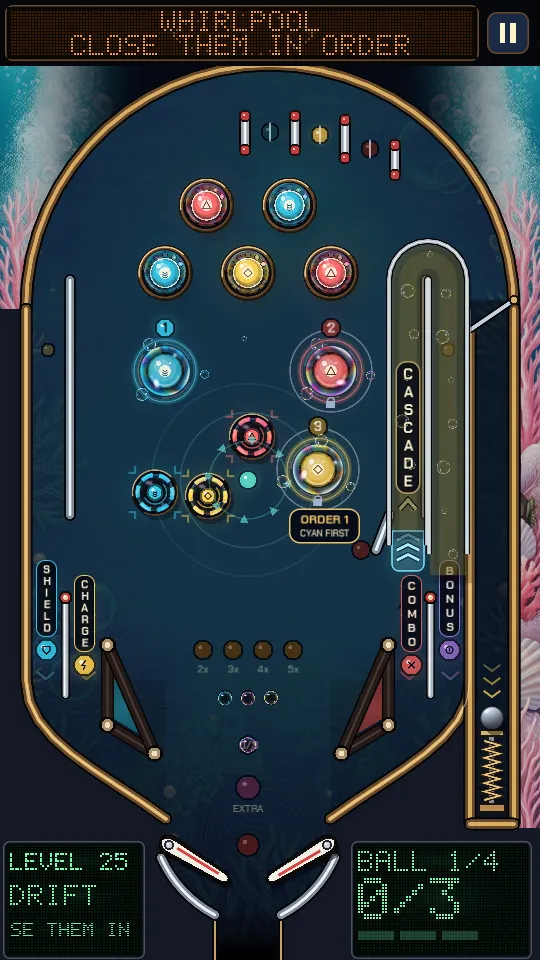
That is what Bubble Pinball sets out to do. It opens in seconds with no download and no account. The keyboard controls will feel familiar to anyone who grew up on the Windows table: the left and right arrows or Z and slash for the flippers, the space bar for the plunger and the up arrow or Shift to nudge. And like those missions and ranks, every table gives you a goal: close the glowing bubbles, but only with a ball charged in the right colour.
There are 100 free tables across five worlds, from a brass cloud workshop to a star-filled crown with low gravity and a black hole, and each world ends with a mini-boss and a boss that play in phases. It is not a copy of any classic, and it is not trying to be. It is a new table built on the same idea: pinball you can start in a moment and keep playing for years. Launch the first table and see if the old reflexes are still there.

Frequently asked questions
Why was the Windows pinball game removed?
It stopped shipping with Windows Vista. A Microsoft developer explained that the 64-bit version had a collision bug that let the ball pass through objects, and the team chose to remove it rather than ship it broken.
Which tables were in the original Full Tilt! Pinball?
Three: Space Cadet, Skulduggery and Dragon's Keep. The version bundled with Windows contained only Space Cadet.
Is Bubble Pinball a remake of a classic PC pinball game?
No. It is an original game with its own tables and rules. It shares the spirit of the classics: instant play, missions and real flipper physics.
Can I play Bubble Pinball with the keyboard?
Yes. Left and right arrows or Z and slash move the flippers, Space or the down arrow pulls the plunger, the up arrow or Shift nudges and Esc or P pauses.
All game names and trademarks mentioned belong to their respective owners. Bubble Pinball is an original game and is not affiliated with, endorsed by or connected to any of them.