
Start with the goal: control, not reflexes
Pinball is a game of controlled risk. Every flip sends the ball somewhere, and a flip without a target usually sends it somewhere bad: into a slingshot, back down the middle or straight at an outlane. The first habit to build is simply not flipping when you do not need to. A ball rolling gently down an inlane will reach the flipper on its own; hitting it early just throws it away.
The second habit is to use each flipper on its own. Pressing both buttons together (the 'double flip') has its uses, but as a default it leaves a gap in the middle and makes it impossible to hold the ball on one side.
Aiming: where the ball meets the flipper
A flipper is a lever, and the point of contact decides the angle. Hit the ball near the tip and it flies towards the far side of the playfield; hit it near the base, close to the pivot, and it goes towards the near side. Timing does the same job: flip late, when the ball has rolled further down the flipper, and the shot goes wider; flip early and it goes higher on your own side.
The practical lesson is that every shot has a spot. Once you know that a given ramp is made from the left flipper when the ball is two thirds of the way down, you can repeat it. That is why stopping the ball first matters so much: a stopped ball always starts from the same place.
Trapping and cradling the ball
Trapping (also called cradling) means holding a flipper up so the ball rolls into the corner between the flipper and the inlane guide and comes to rest. From there you can breathe, look at the playfield and decide what to shoot. It is the single most useful skill in pinball.
There are several ways to get the ball into a trap:
- Hold-up trap: when a slow ball is heading for a flipper, simply raise it early and hold. The ball rolls down the raised flipper and stops in the crook.
- Drop catch: when the ball comes down onto a flipper you are already holding up, let go of the button just as the ball arrives. The flipper drops, absorbs the speed and the ball settles; raise it again to trap.
- Live catch: when a fast ball comes straight at a lowered flipper, flip up at the exact moment of contact. Done right, the flipper cushions the ball instead of firing it. It takes practice; start with the other catches.
- Dead bounce: let a ball fall on a lowered flipper that you do not move. It bounces across to the other flipper, which you raise to trap it.
Passing the ball between flippers
Some shots are only possible from one flipper, so you need ways to move a trapped ball to the other side safely.
The post pass: release a trapped ball, let it roll down towards the tip and give the flipper a short flip so the ball hits the rubber post at the bottom of the slingshot on the same side. It rebounds across to the other flipper, which catches it. The tap pass is gentler: from a trap, a very quick tap nudges the ball so it rolls over to the opposite flipper. Both feel awkward at first and become automatic after an evening of practice.
Nudging without tilting
Nudging is pushing the machine to change the ball's path. On a real table you push from the front with the palms of your hands; a small shove at the right moment can turn an outlane drain into an inlane save, or unstick a ball that is bouncing between the slingshots. The most common rescue is to nudge when the ball is about to hit the post between the inlane and outlane, so it drops on the safe side.
The machine allows only so much. A tilt mechanism measures the shaking, gives a warning or two and then tilts: the flippers go dead and the ball, plus its end-of-ball bonus, is lost. Two rules keep you safe: nudge early and gently, and never nudge twice in a row while a warning is still fresh. In Bubble Pinball you nudge with the up arrow or Shift, and the same warning-then-tilt rule applies.
Reading the ball and the table
Watch the ball, not the lights, but learn the lights too. The inserts on the playfield tell you which shots are lit, which modes are running and what the next goal is. Good players spend their trapped moments reading them.
Learn where balls come back from each shot. A ramp usually returns to a known flipper; an orbit may go round and drop into the pop bumpers. Shots that return safely are the ones to repeat. Also learn the dangerous ones: the balls that come off a target straight down the middle, or that ricochet off a slingshot towards an outlane. When a shot keeps hurting you, stop shooting it until you need it.
Surviving and scoring in multiball
Multiball puts two or more balls on the playfield at once, and it is where most big scores come from. The mistake is to flail at everything. Instead, trap one ball on one flipper and keep playing the others with the free flipper. When a second ball comes to the trapped side, you can often let it hit the held ball and settle next to it.
Shoot the jackpot shots, not whatever is closest. If all the balls are on one side, a double flip to save them is fine. And if you lose all but one ball, return to calm single-ball play immediately.
Applying it in Bubble Pinball
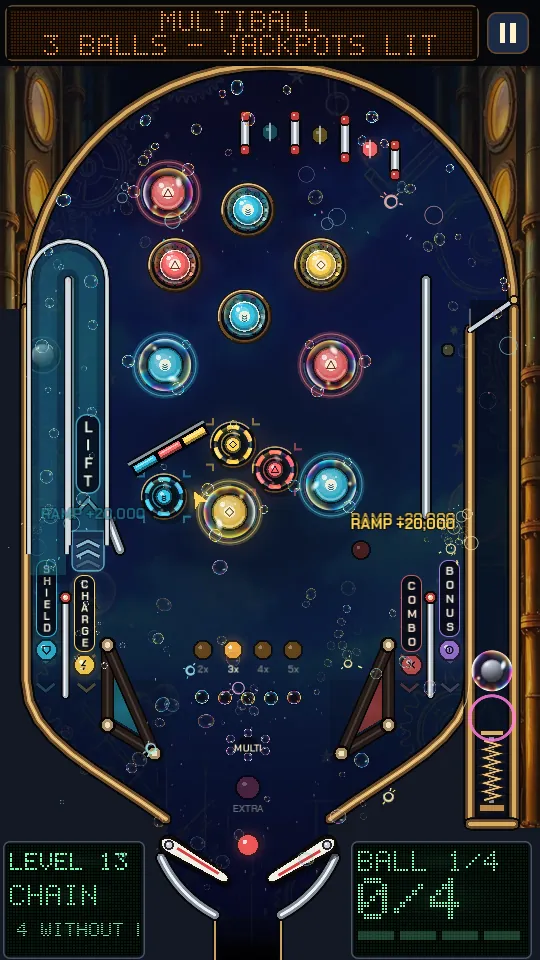
Everything above works in Bubble Pinball because the game uses real flipper geometry, slingshots, pop bumpers and ball physics. Trapping is essential there, because the game adds a decision before each shot: a bubble only breaks when a ball charged with its colour hits it. The loop is charge, trap, aim: roll through a coloured ring, catch the ball on a flipper, then pick the bubble.
A few habits help on every table:
- Use the 8-second ball saver at the start of each ball to take riskier shots.
- Light the SHIELD lane before a hard shot: it gives you another 6 seconds of safety.
- Let balls roll down the side lanes; all four feed a flipper, so the ball arrives ready to trap.
- In multiball, keep one ball trapped and aim the others at bubbles: each one closed is a JACKPOT.
- Short on colour? The CHARGE lane paints the ball with the colour of an open bubble.
Frequently asked questions
How do you play pinball for beginners?
Launch the ball, keep it in play with the flippers and score by hitting targets. The first skill to learn is trapping: hold a flipper up so the ball stops, then aim a shot instead of flipping at random.
Should I press both flippers at the same time?
Not as a habit. Using each flipper separately lets you trap and aim. Double flipping is only useful in emergencies, such as a ball dropping straight down the middle.
How do you avoid a tilt?
Nudge early and gently, and leave time between nudges. A tilt comes after warnings; ignoring a fresh warning is what usually ends the ball.
Can I practise pinball technique online?
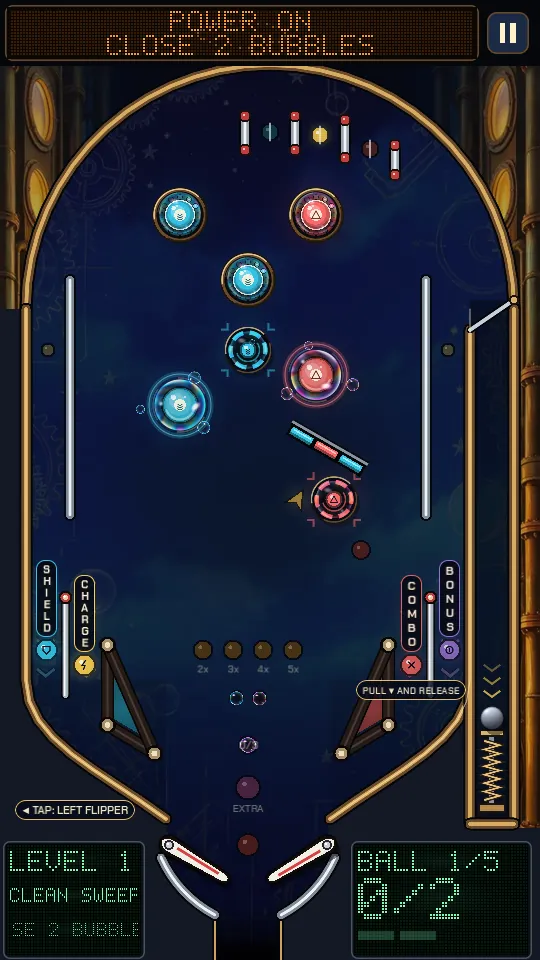
Yes. Bubble Pinball runs free in any modern browser on phone, tablet or computer, with real flipper geometry, so trapping, passing and nudging work as on a physical table.